
Inside Prentiss County Tax Records
Prentiss County splits the work. The Tax Assessor locates, classifies, and values taxable property. The office maintains the ownership maps. The Tax Collector receives real and related taxes and pursues unpaid accounts. The Chancery Clerk holds the land records. The clerk also runs the tax-sale and redemption trail that state law describes.
| Field | What it documents | Official route |
|---|---|---|
| Land, improvements, total | Separate appraisal components and combined value | Assessor's Delta card |
| Assessed value | Taxable base after the state class ratio | Assessor's Delta card |
| Homestead and exemption codes | Account flags for the displayed year | Assessor |
| Jurisdiction lines | County, city, and school amounts when present | Delta detail |
| Paid and balance | Dated payment status | Collector and Delta |
| Sale and redemption | Delinquency, sale, release, and deed leads | Collector and Chancery |
Mississippi DOR gives the formula plainly: true value, times the assessment ratio, times millage. Class I owner-occupied single-family real property is assessed at 10 percent of true value. Class II, covering other real property, sits at 15 percent. Check the class before trusting any number. An assessed value and tax bill are not a sale price.
Search Prentiss Tax Accounts
The Prentiss real-property form offers five one-field routes into the accounts. Start with the most exact clue you have, then save the tax year and the records-updated date before comparing any amount.
| Search route | Form detail | Best use |
|---|---|---|
| Name | Last first; 35 characters | Known account holder |
| Address | Separate number and street | Known situs |
| Parcel | 20 characters | Exact tax account |
| Section/Township/Range | 2/3/3 characters | Rural land |
| PPIN | 6 characters | County property ID |
Review the official form before the captured field view.
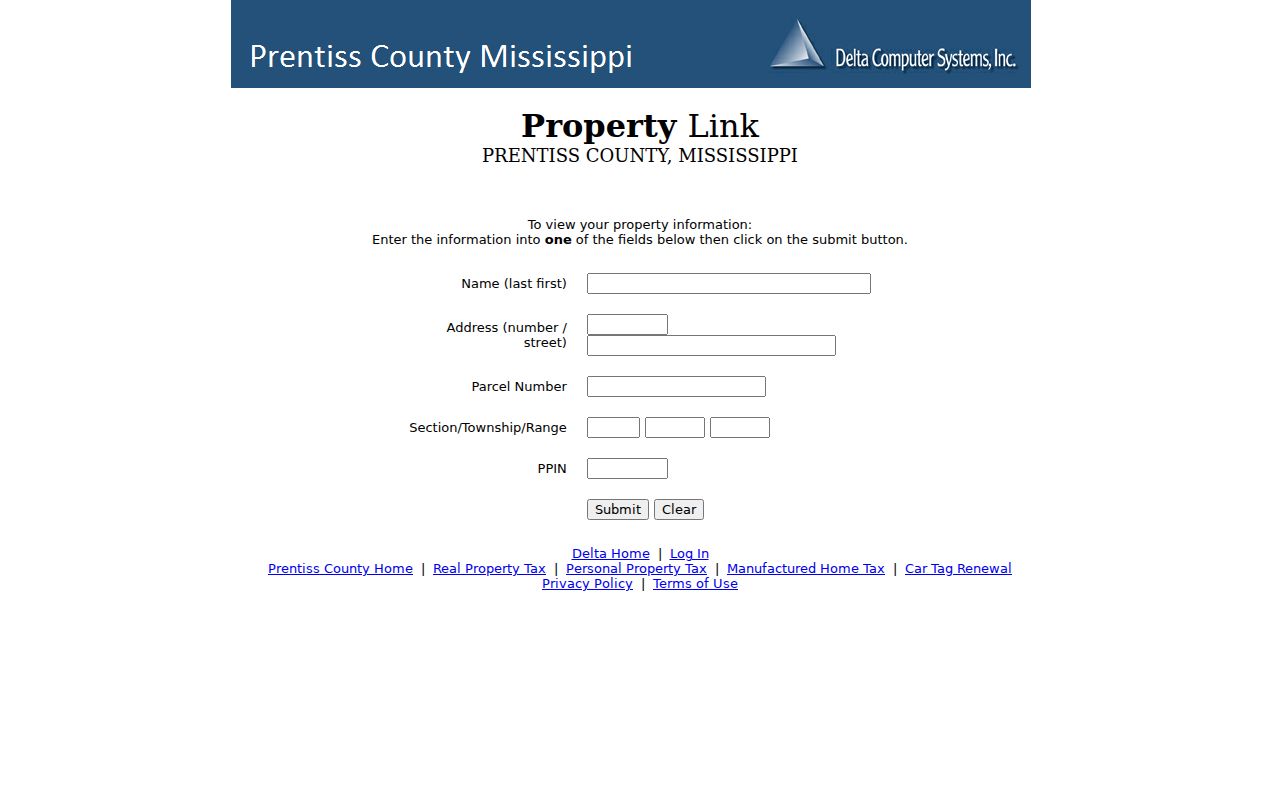
The one-field design rewards an exact parcel or PPIN once an address result pins down the account.
Look Up a Prentiss Tax Bill
Keep appraisal and collection questions separate. Delta supplies the card and its displayed tax lines. The Prentiss County Tax Collector can confirm receipts, balances, delinquency, and the annual sale work, while Chancery records supply recorded sale, release, redemption, or deed references.
- Search Delta by one field and open the exact parcel. Confirm situs, parcel, PPIN, and tax year before reading amounts.
- Record land, improvement, total, assessed value, each jurisdiction line, paid total, and balance as displayed.
- Check homestead and exemption codes, but ask the Assessor what a blank or code means for that year.
- For delinquency, contact the Collector and search Chancery tax-sale and release categories. One “no sales” line is not a full history.
- Assessed value
- The taxable base after the applicable class ratio.
- Millage
- The rate applied to assessed value to calculate tax.
- Homestead exemption
- Relief tied to qualified ownership and primary-residence use.
- Tax lien
- A claim tied to unpaid tax that requires official status research.
Read a Prentiss Tax Card
One sample card shows how much context a single record can carry. It listed $4,500 in land and $70,660 in improvements. That produced a $75,160 total and $11,274 in assessed value. The tax lines read $1,383.32 county, $430.10 city, and $0 school. The total was $1,813.42 paid in the displayed 2025 tax year. The page also carried a September 10, 2026 update date. Those figures document one demonstration account, not a county average or a quote for another parcel. The card held owner, mailing address, situs, acres, PPIN, S/T/R, legal text, book and page, tax district, and tax-sale history fields. A CITY line adds municipal-tax context. Still, it cannot prove when the land entered city limits. Note: Date-stamp every Prentiss County property tax result. The tax year and the portal update date answer different timing questions.
Prentiss Homestead Filing Dates
Applications for homestead relief run through the Assessor. The Mississippi DOR homestead page gives a January 1 through April 1 window. Applicants generally must own and occupy the primary residence on January 1. The ownership instrument must be recorded before January 7. The county's own how-to page says January 2 through April 1. Confirm the local opening day, since those sources differ. Reapplication may follow a change in description, ownership, use, or occupancy. Marriage, divorce, remarriage, death, or another eligibility fact can also require it. Tier 1 regular relief may provide up to a $300 credit based on value. Tier 2, for age or disability, applies to the first $7,500 of assessed value. It may treat later increases differently. Recent veteran and surviving-spouse provisions changed too. No code section alone proves eligibility.
Trace Prentiss Delinquent Taxes
A delinquent account can leave paper in several offices. Start with the tax year, parcel, PPIN, legal description, amount, and payment status. Ask the Collector for notices and receipts. Then search the Chancery records. Look for County Tax Sale, County Tax Release, Municipal Tax Sale, and Municipal Tax Release. Record the certificate, redemption, release, and deed dates. Do not shrink the history to one label. The DOR appraisal guidance places sales on the first Monday of April when optional. Otherwise sales fall on the last Monday of August. Verify the Prentiss date. A tax-sale certificate is not fee-simple title. The statutory steps must be finished, and the deed status reviewed. The delinquent-tax payment route sends confirmation by email. County directions say the release for a delinquent tax-sale receipt is mailed to the address on file. Call 662-728-8151 if nothing arrives within 14 days. County-linked prompts conflict between 2.25 and 3.75 percent service fees. Confirm the charge at checkout.
Challenge a Prentiss Assessment
DOR says an assessment appeal normally starts on the first Monday of August. That date falls before the tax due date. The appeal begins by requesting a Board of Supervisors hearing. Confirm the current Prentiss procedure with Tax Assessor Bob Maddox at 662-728-4349. Waiting for the later bill can miss the assessment-roll review period. Bring parcel and PPIN, the tax year, property class, and the challenged values. Add correct measurements and condition facts, comparable evidence, and any legal-description correction. A recent deed price can be relevant, but it does not automatically set assessed value. Ask how evidence must be filed. Keep the board's written action for your records.
Appeal window. Contact the Prentiss County Assessor before the August review period and ask for the current hearing request method and final filing date.
Route Prentiss Tax Questions
Getting tax answers in Prentiss County means asking the right office. Value, classification, map, and homestead questions belong to the Assessor. Questions about payment, balances, receipts, delinquency, or the annual tax sale go to Tax Collector Homer “Rusty” Cole Jr. Call 662-728-5044. Recorded sales, releases, redemptions, deeds, plats, and liens are Chancery Clerk territory, reachable at 662-728-8151. The split matters even when a portal looks complete. A blank exemption code is not a legal finding. A card that shows no tax sales does not prove every historic year was checked. A zero balance settles nothing about title. Tie each answer to its custodian, tax year, parcel, and search date.
Mailed requests should list the exact account identifiers and years. Say whether a receipt or certified record is needed. Ask the custodian for a current fee estimate before any copies are made.
Prentiss County's Annual Tax Cycle
The assessment account runs on its own calendar. The deed index runs on another. Under Mississippi guidance, real-property taxes attach to the owner of record on January 1. Bills typically arrive in November or December, and payment falls due the following February 1. Delinquency adds interest and penalties and can end in a statutory sale. Sale and notice schedules shift, so confirm each operational date with the county.
That calendar is why a deed filed mid-year and the tax card for that year's roll can carry different names. Neither record should be quietly overwritten with the other. Instead, log the assessment date, the tax year, the deed recording date, the portal update date, and the payment date. The newest recorded deed often reflects ownership first. The assessor still controls the official assessment account.
Check Prentiss Value Components
Check the facts under a value before contesting it. Compare acreage, land class, improvement description, situs, tax district, homestead status, parcel split or merge history, and the legal description on the card. An improvements figure cannot establish a build date. It cannot prove work had a permit either. A mailing address is not proof of occupancy.
The Mississippi DOR supervises the statewide appraisal framework. The county Assessor applies it to the local roll and presents that roll for county review. Ask the Assessor to walk through the class and the specific card fields behind the number. When a measurement, use, or parcel description is wrong, hand over a clear record showing the correction. Keep valuation evidence separate from a boundary survey and from title evidence.
Read Prentiss City Tax Lines
A Prentiss County tax card may break the bill into separate COUNTY, CITY, and SCHOOL lines. Those entries show which amounts build the total. Record each line separately, with the tax district and year, whenever you compare property tax records. A city line is not a municipal-boundary survey. It cannot prove the effective date of annexation.
The caution matters most for Booneville mailing addresses that sit outside city limits and for Baldwyn, a city that spans Prentiss and Lee counties. First establish which county holds the parcel. Then confirm the city tax context through the county account and any current boundary or annexation record. Postal routing alone never picks the correct tax office.