
Prentiss County Deed Types
The Chancery Clerk keeps Prentiss County's deed records. A deed documents a conveyance. It names the parties, the legal description, and the terms of the transfer. In the portal, deeds carry the code LRD. Related entries may point to a trustee, an estate representative, a tax process, or a corrective filing, so read the full record before deciding what interest passed.
| Deed Type | What It Does | Common Use |
|---|---|---|
| Warranty deed | Conveys the stated interest with warranties written in the deed | Ordinary purchase conveyance |
| Quitclaim deed | Conveys whatever interest the grantor has without the same warranties | Family transfer or title cleanup |
| Trustee's deed | Records a transfer made by a trustee acting in a stated capacity | Trust or deed-of-trust process |
| Executor or commissioner deed | Records a conveyance under estate or court authority | Probate, partition, or judicial sale |
| Tax deed | Documents a later stage of the statutory tax-sale process | Delinquent-tax title trail |
A deed of trust secures a debt. It is not proof of a new owner. A cancellation, release, or substitution may follow. A construction lien, judgment, federal tax lien, or lis pendens is notice that demands status research. Nothing should be called active or dispositive until later releases and court records are checked.
Prentiss County's Recording Office
Deeds in Prentiss County are recorded by the Prentiss County Chancery Clerk, whose office sits at 100 North Main Street in Booneville. Mail reaches the office at PO Box 477, Booneville, MS 38829, and the phone number is 662-728-8151. Weekday hours run 8 a.m. to 5 p.m., though holidays can change that schedule.
The recording books hold far more than deeds. Deeds of trust, construction and condominium liens, federal tax liens, powers of attorney, lis pendens, plats, older land rolls, tax receipts, judgments, board minutes, and will-related records all sit in the same indexes. When a broad party search pulls too much noise, ask the clerk which index family fits your deed records question.
For official recorder contact and duties, the county's own page lists the clerk's responsibilities in full.
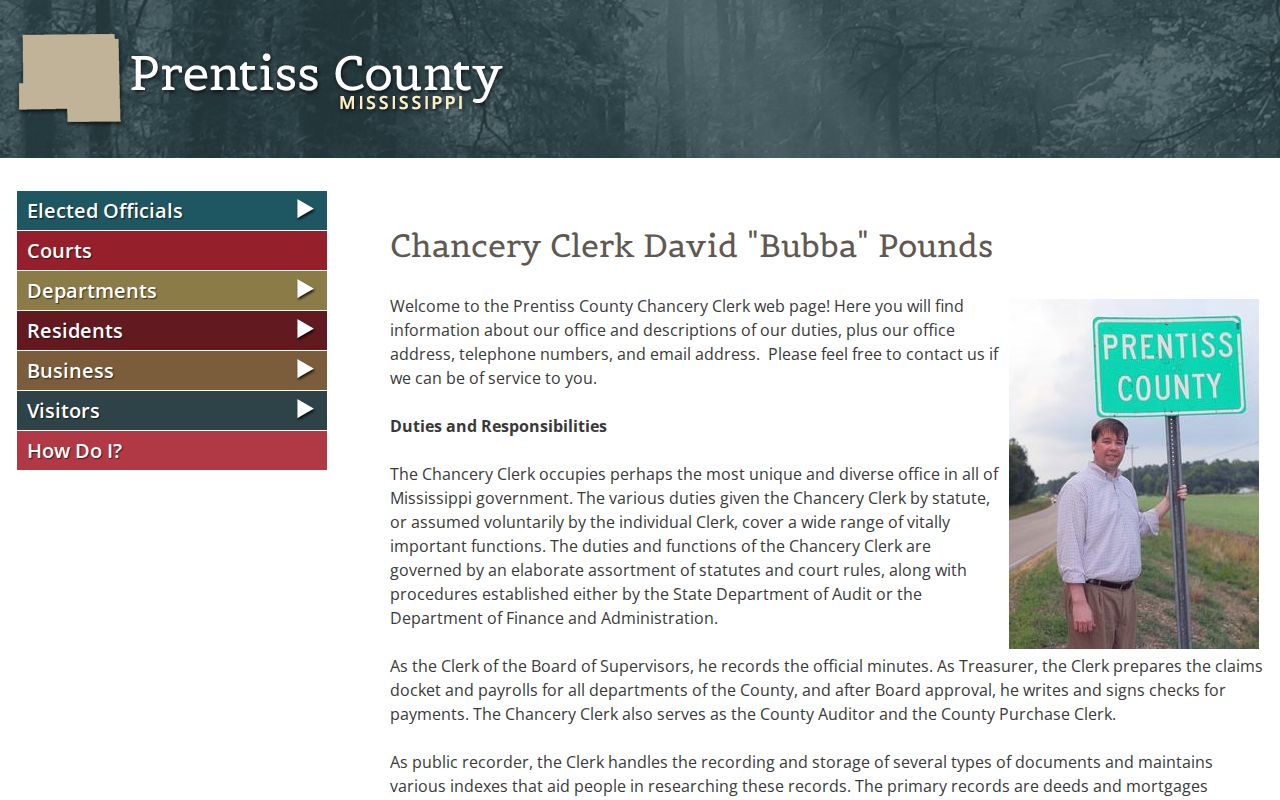
The Chancery Clerk's office page lists current fee links, so confirm recording costs there before ordering any copies.
Filter Prentiss Deed Records Precisely
The DuProcess land index beats a plain name box. Its filters reward preparation. Anchor a search in stable facts from a tax card, old deed, abstract, or plat, and remember the online index is expressly unofficial while the courthouse index controls.
| Portal field | Input | Deed-search use |
|---|---|---|
| Party scope | To, From, or Both | Separate grantee acquisitions from grantor transfers |
| Name | First, middle, last, or company | Test full names, initials, trusts, estates, and entities |
| Date | Start/end or recent-day choices | Narrow a transfer period |
| Instrument | Type, number, book, page | Target a known record or family |
| Land | Parcel, PPIN, subdivision, lot/block, S/T/R | Confirm that a party hit concerns the same land |
The portal's instrument list runs long. Options include Deed, Deed Of Trust, Assignment, Cancellation, Construction Lien, Judgment, Lis Penden, Modification, Partial Release, Release, Substitution Of Trustee, County and Municipal Tax Sale and Release, and Power Of Attorney, among others. One quirk: the interface spells it “Lis Penden.”
Read Prentiss Grantor-Grantee Records
A grantor transfers the stated interest. A grantee receives it. To trace a chain, first locate the deed into the current owner, then read that deed's prior references and legal description rather than trusting the index name alone. A shared surname or address can point to different land.
- Find the current owner's acquisition deed by searching that party as grantee, or “To,” within a sensible date range.
- Open the instrument and copy the grantor, recording date, legal description, consideration language, and prior book/page.
- Search that grantor as a grantee in an earlier period. Match the land through legal description, plat, acreage, parcel, or prior reference.
- Repeat the process. Search deeds of trust, releases, liens, tax-sale instruments, and court or estate records when the chain calls for them.
- Move to the official courthouse index and older books when the online coverage ends or a volume is unclear.
- Grantor
- The party who conveys the interest stated in an instrument.
- Grantee
- The party who receives that stated interest.
- Chain of title
- The linked sequence of recorded transfers for the same land.
- Book/page
- A recorded volume and page citation used to retrieve an instrument.
- Instrument number
- A separate index identifier assigned to a recorded filing.
Older Prentiss County Deed Books
An established land-title directory reports online coverage of Prentiss County land records starting in 2008. Treat that as a coverage lead, nothing more. The Virtual Index does not publish its earliest year. Older chains may need the official courthouse index, scanned or paper deed books, map books, sectional indexes, patents, and original-entry material.
Once a citation is in hand, the Prentiss Virtual Index narrows fast. Its controls are Type, Book, and Page.
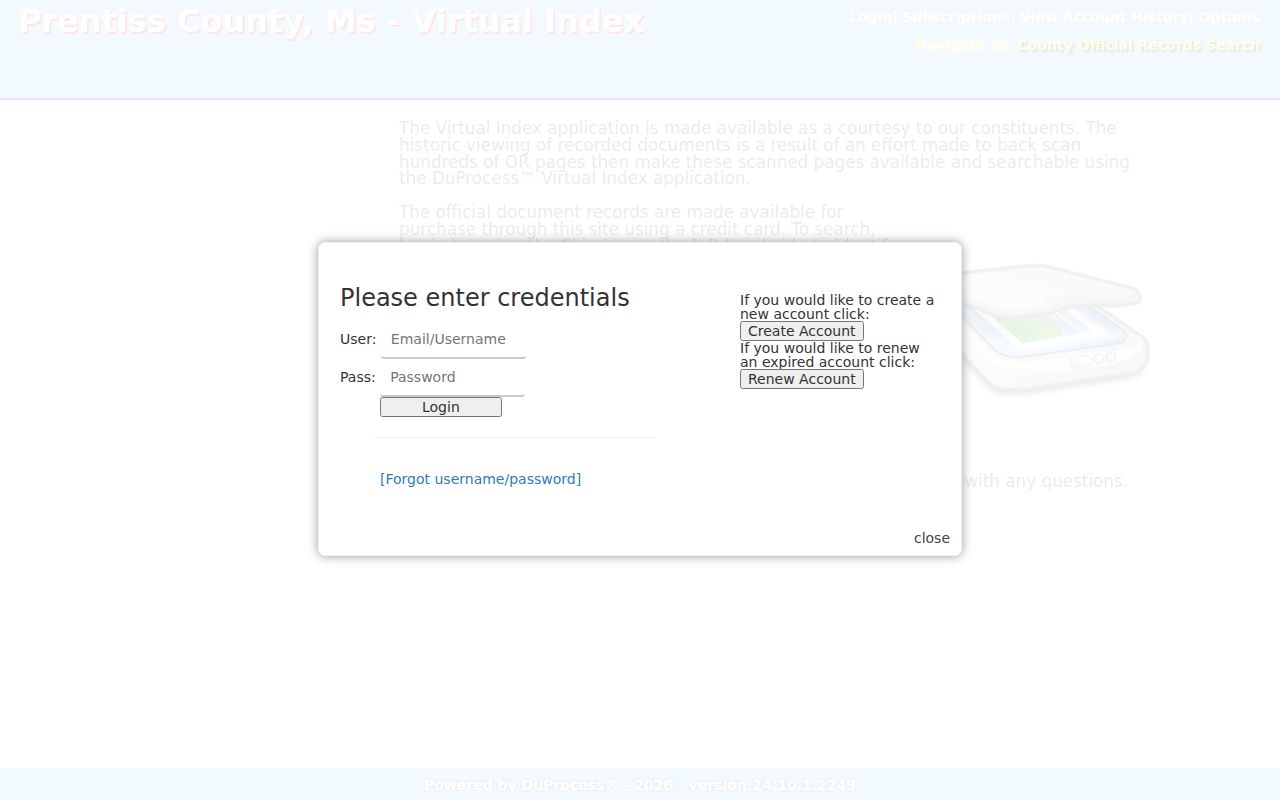
Retrieval from the Virtual Index helps. Its informational image is no substitute for an official certified copy, though. A missing span in the records belongs with the Clerk, not with guesswork about a courthouse fire or countywide land-record loss.
Mississippi State University holds Prentiss County material worth checking. Its lists include Deed Records 1880-85, Land Sale 1836, Chancery Court Dockets Index Book 1, and an Index to Estate Cases. The George E. Allen Library adds local-history and genealogy resources. These are discovery sources. For anything official, the Chancery Clerk remains the source.
Prentiss Plats, Easements, and Minerals
A deed chain leans on more than deeds. A plat fixes lot and block geometry. It also records roads, dedications, and notes. Easements and rights of way govern access, while oil-and-gas leases and royalty deeds can move mineral interests apart from surface ownership, so later releases and amendments deserve the same search as the first filing.
For a subdivision parcel, use the portal's exact label. Then obtain the plat book and page. Booneville Trace Phase 1, Cedar Ridge Phase II and III, Eastover Phase II, and the separate Forrest Hills phases are examples of dropdown vocabulary in the county. The label alone neither proves the city boundary nor replaces the plat.
Rural land demands precision. Keep Section, Township, Range, acreage, road references, and quarter-section wording exact. A tax-card legal fragment can help locate the deed, but it is not itself a survey.
Monitor New Prentiss Land Filings
Prentiss County runs a Property Fraud Alert service. It sends notice when a monitored person or company name shows up in new recording activity. Signing up means accepting terms and choosing the person or company to watch. You also add name variants, confirm contact details, and verify an email address. The signup page displays no fee. The official form is the place to see the exact terms. It also shows the field layout before you enroll.
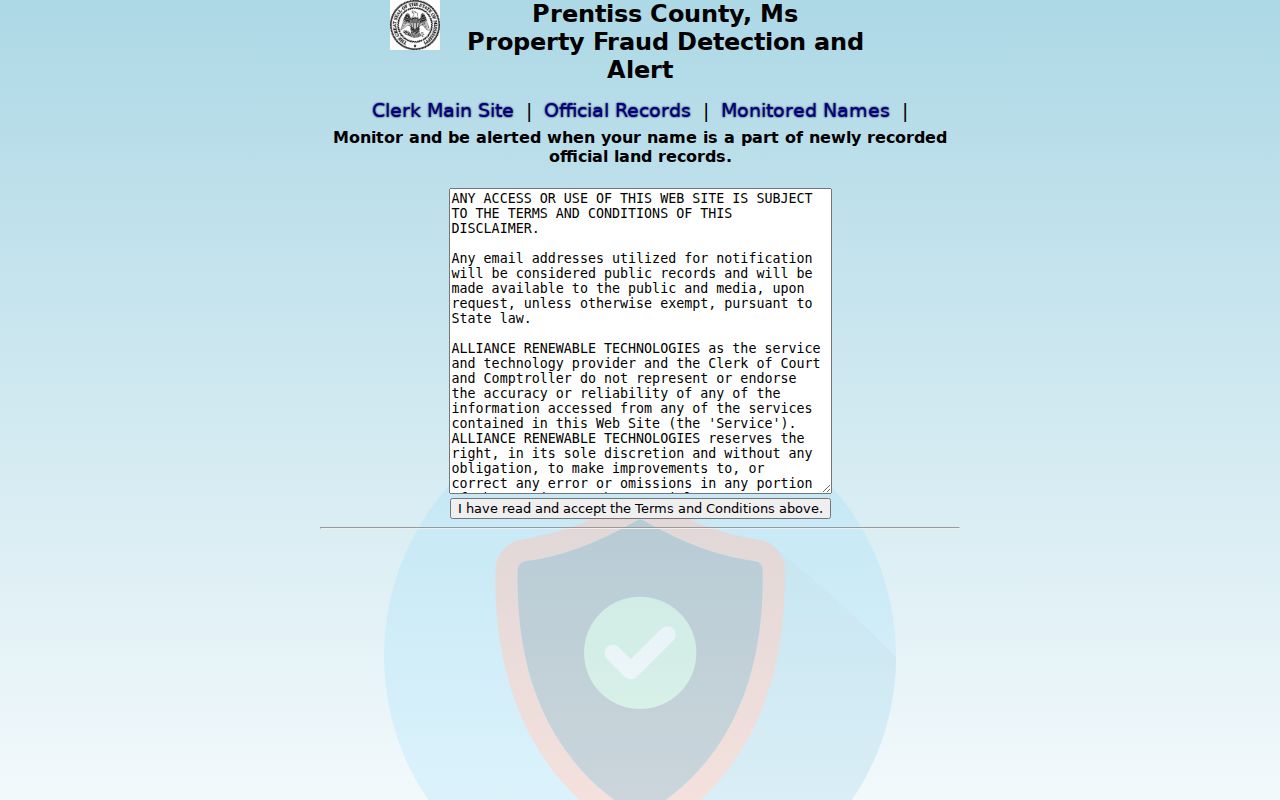
The alert service only notifies you. It proves no fraud, fixes no title, and insures nothing. Before acting, confirm the instrument number and image with the Clerk, and run full-name, middle-initial, and no-middle-name searches, since the service itself shows those variants.
Order a Prentiss County Deed Copy
There are three ways to get a deed copy. Order online, visit the Chancery counter, or mail a request with strong identifiers. Include the instrument type plus its number or book/page citation. Add the approximate filing date and the party names. Include the parcel or PPIN and the legal description. Decide whether a plain copy or a certified copy suits your use. Ask the Clerk for the current fee before paying.
The county fee sheet dates to July 1, 2007. It sets clerk-made copies at $0.50 and certified copies at $1.00. Online card purchases are final and nonrefundable. A 3.5% service fee applies, with a $2 minimum. Those charges are separate from recording fees. Those shift with the instrument, its page count, and its lots or sections. Confirm every current amount with the Clerk.
The same dated schedule prices deed and lease filings at $11 for the first 15 pages. Extra pages cost $1 each. Each added section or subdivision lot costs $1 more. A deed of trust runs $16, and plats cost $10 plus additions. Treat these figures as background, not a quote.
Recorded, not guaranteed. Prentiss County deed records show filed instruments, not a title opinion; unrecorded interests and unresolved defects may still exist.
Prentiss Estate Deed Trails
An estate transfer rarely looks like a normal sale. Expect a trail instead of one deed. Search the decedent, the estate caption, the executor, the administrator, heirs, trustees, guardians, and commissioners. Look in both Chancery court and land records. Useful papers range from a will and letters to an heirship affidavit, inventory, and final accounting. The set may also include a partition order, executor deed, commissioner deed, or court order.
The fee schedule lists an heirship affidavit at $11. But that filing is only a lead. It may not control the transfer. Match each court reference and deed to the same legal description. Vital and genealogy records can settle identity or chronology, subject to access rules. Yet they never replace the probate file or the recorded conveyance.
Names shift form over time. Test initials, middle names, ET UX spellings, former surnames, and each fiduciary's stated capacity. For a company or trust, search the exact indexed name. Also try predecessor or related trustee names. The deed itself should settle who signed, in what role, and under what claimed authority.